



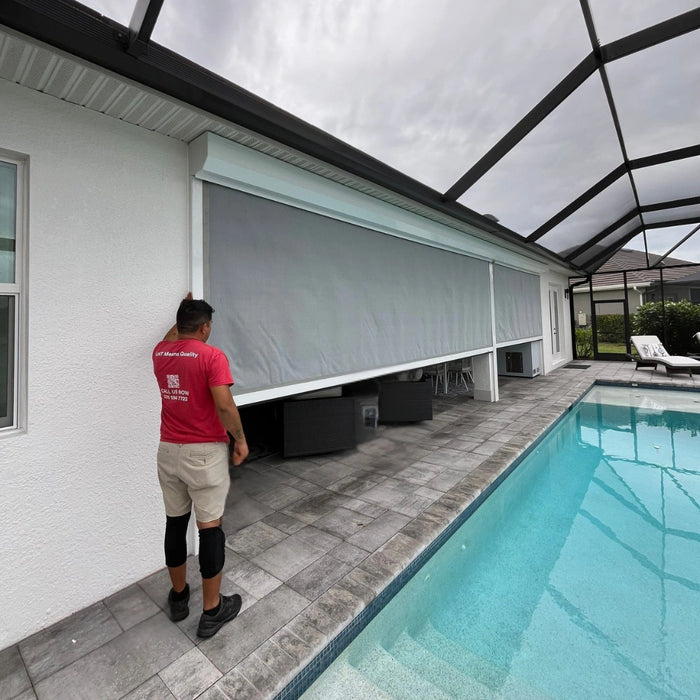


Solar Screens vs Insect Screens: Which Is Right for Your Southwest Florida Lanai?
by Eduardo Roman on Sep 28, 2026When you weigh solar screens vs insect screens for a lanai, start with the problem you want to solve. Choose insect mesh where bugs, breeze and a clear view matter most. Choose solar fabric for the side of the lanai that takes the afternoon sun and glare. You don't have to pick one for the whole lanai, because each opening gets its own screen. Neither one is hurricane protection, so if storms are your concern, look at our hurricane screens, which are a separate product. We're Advanced Hurricane Technology, a Fort Myers manufacturer since 1994, and we install retractable mosquito and solar screens that roll up into a housing when you don't need them.
Solar screens vs insect screens at a glance
Here's how the two compare on the same opening.
| Insect screen | Solar screen | |
|---|---|---|
| Main job | Keep bugs out and let the breeze in | Cut glare and solar heat on sunny openings |
| What it stops or cuts | Mosquitoes and other insects (for no-see-ums, see below) | Cuts much of the glare and solar heat (for bugs, see below) |
| View out | The clearest view | Still a view out, depending on the weave |
| Breeze | Lets air through | Less breeze than insect mesh |
| Daytime privacy | Little | More, depending on the weave and color |
| Privacy at night with lights on inside | Little | Less than by day: people outside can see in, more easily through darker colors |
| Cost for the same opening | The lower-cost option | About 35 percent more |
| Storm protection | None | None |
Insect screens: for bugs, breeze and a clear view
An insect screen is a fine mesh that keeps insects out while letting air through. It suits openings where you sit out after sunset and want to look straight through to the yard, the pool or the water.
Southwest Florida keeps that mesh busy. The Lee County Mosquito Control District describes Lee County as one of the most prolific mosquito breeding habitats in the world, with 56,000 acres of salt marsh, and it advises residents to use window and door screens. The CDC gives the same advice: use screens on windows and doors, and repair any holes in them.
What about no-see-ums?
No-see-ums, the tiny biting midges, need a closer look. According to UF/IFAS, Florida species average about 1.5 mm (0.06 inch), and several of them breed in coastal marshes, swamps and mangroves, where they can build up to huge numbers. UF/IFAS also notes that regular window screens don't keep them out, while no-see-um screen has openings small enough to stop them. The Lee County district explains that it sprays only when mosquito counts reach its treatment thresholds, not because no-see-ums are around. If you live near the water, ask which mesh your quote includes and whether it's a no-see-um mesh.

Solar screens: for afternoon sun, glare and heat
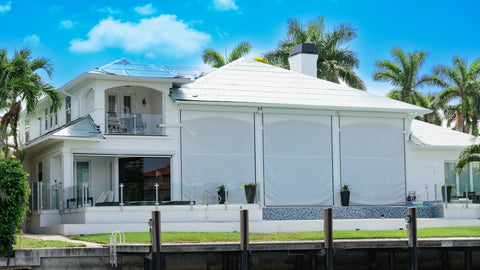
A solar screen is a fabric with a denser weave, mounted on the outside of the opening. The U.S. Department of Energy's Building America Solution Center explains that exterior solar screens reduce glare and solar heat gain while keeping a view outside, and that the heat the screen absorbs stays outside the home. "Solar" refers to the sun the fabric blocks, not to solar power.
Solar screens earn their keep on east and west exposures. The Solution Center notes that exterior roller solar screens work well there, because the sun comes in low on those sides and a roof overhang struggles to block it. On a Southwest Florida lanai, that usually means the west side, the one that bakes after lunch.
When you compare fabrics, you'll hear the term openness factor. It's the share of open space in the weave, and according to Efficient Window Coverings it runs from about 1% to 25% for solar screens. A lower number blocks more sun and keeps less of your view, and a higher number does the opposite. Darker colors generally give the best mix of glare control and view, and our screen colors include Black and Grey.
The same site also shows why the screen goes on the outside. A solar screen's shading coefficient, a measure of how much of the sun's heat gets through (lower means less), is 0.14 to 0.33 when it's installed outside and 0.50 to 0.70 when it's installed inside. Those are general figures, not a rating for any one fabric.
For privacy, solar fabric helps in daylight, because it's harder to see in from outside. At night it works the other way. As one solar fabric maker points out, with the lights on inside, people outside can see in. The same maker notes that lighter colors give more privacy, while darker colors are easier to see through, so pick the color with both the view and your privacy in mind.
Does a solar screen keep bugs out too?
Solar fabric has a denser weave than insect mesh, which is why it blocks more sun and lets less breeze through. It's natural to assume it stops bugs as well. Whether a particular fabric keeps out the smallest insects depends on that fabric, though, and you'll find different answers online. The honest advice: compare samples before you choose. If sun and bugs are both a problem on the same opening, ask about the options for that opening at the free in-home visit, and ask to see both fabrics side by side.
Mixing screens around one lanai
Because each opening gets its own screen, you can choose by side. A lanai with a west wall that takes the late sun and a south side facing a canal, for example, might get solar fabric on the west openings and insect mesh on the rest.
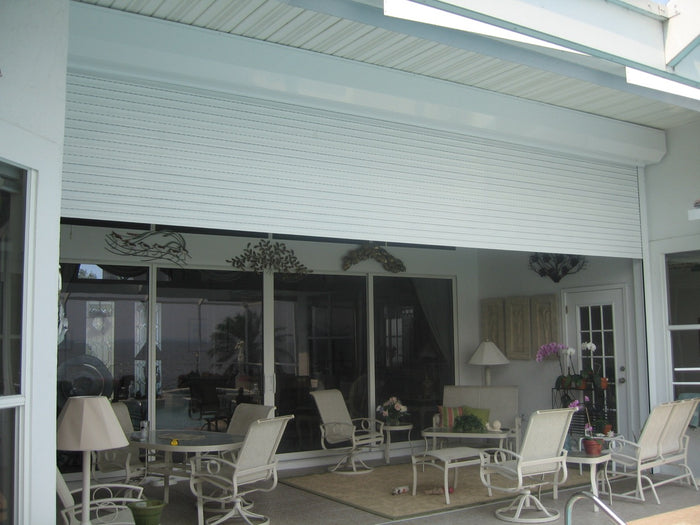
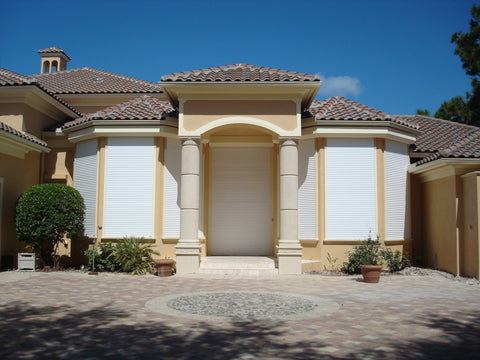
Both types are retractable. You lower a screen when you need it, it runs down side guides, and it rolls back into the housing at the top when you don't. Each screen can be a manual spring retractable model that you raise and lower by hand, or a motorized one that you run with a remote control or a wall switch.
Tracks and housings come in Beige, Ivory, White or Bronze. The screen and webbing come in Beige, Ivory, White, Black or Grey, so you can match the house and stay with colors your HOA allows.

2026 installed price ranges
These are installed price ranges for homes in Lee County and Collier County, from the same pricing behind the instant estimate on our free in-home visit page. Each range runs from a manual screen at the low end to a motorized screen at the high end.
| Opening | Insect screen | Solar screen |
|---|---|---|
| One window or sliding glass door, up to 8 by 8 feet | about $1,600 to $3,400 | about $2,200 to $4,500 |
| One lanai bay, 12 by 9 feet | about $2,600 to $5,400 | about $3,500 to $7,300 |
| Wide lanai opening, 16 by 9 feet | about $3,000 to $6,100 | about $4,000 to $8,200 |
| Whole lanai, three 12 by 9 foot bays | about $7,900 to $16,100 | about $10,700 to $21,700 |
These ranges are before any permit, access or removal fees, and your final price is confirmed at the free in-home measure.
What moves the price:
- Fabric. Solar fabric runs about 35 percent more than insect mesh for the same opening and the same operation.
- Motor. Motorized runs about 40 percent more than manual. For one 12 by 9 foot bay in insect mesh, manual is about $2,600 to $3,900 and motorized about $3,700 to $5,400.
- Size and number of openings. Each opening is billed at a minimum size, so a small window costs about the same as an 8 by 8 foot slider. A single opening over 120 square feet gets a lower rate per square foot, so the 16 by 9 foot opening costs only a little more than the 12 by 9 foot bay.

What these screens are not: hurricane protection
Mosquito and solar screens are comfort products. They aren't hurricane, storm or impact protection, and they don't replace shutters or hurricane screens. The FAQ on our product page puts it plainly: asked whether these screens are hurricane-rated, the answer is no.
If you also want storm protection for the lanai, that's a hurricane screen: a separate product designed for storms, with its own warranty, lead time and price. You can look through our hurricane screen options and ask about both at the same visit. Already comparing hurricane screens? See how our hurricane screen fabrics compare.
Warranty, lead time and what to ask at the visit
Under AHT's Limited Warranty, bug screen and solar screen carry a 1-year term, and the written Limited Warranty controls.
Our typical lead time for mosquito and solar screens is 3 to 4 weeks. That's a range, not a promised date.
A short list to bring to the visit:
- Which fabric goes on which opening, based on where the sun hits and where you want the breeze.
- If no-see-ums are a problem where you live, which mesh your quote includes and whether it's a no-see-um mesh.
- Manual or motorized for each screen.
- Track, housing and screen colors your HOA allows.
- The written warranty term for each product on the quote.
Products in this article

Mosquito and Solar ScreensRetractable insect and sun screens for lanais. Comfort products, not storm protection.
To see the fabrics, colors and operating options, look through our mosquito and solar screen options. Then book the free in-home visit: we'll measure each opening, talk through where you get sun and where you get bugs, and confirm your price in person. The same page has our instant estimate if you'd like a ballpark first. Or call us at (239) 251-0856, Monday to Friday, 7:30 am to 4:00 pm.
Advanced Hurricane Technology · FL Lic. CBC1258522 | SCC131153977


